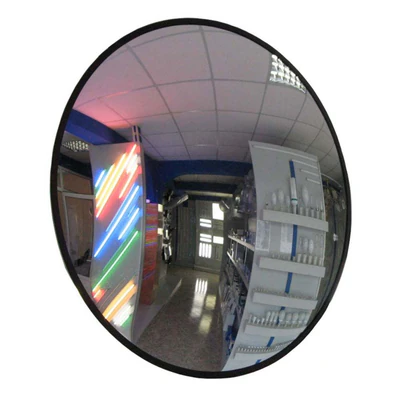
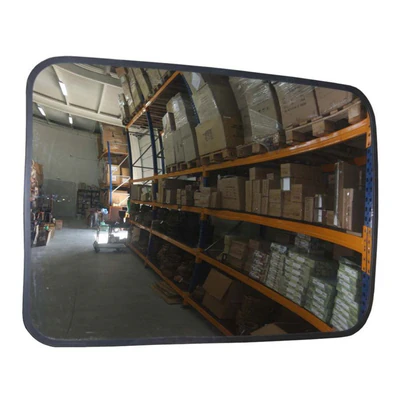
Surveillance mirrors ensure full visibility in traffic, parking lots and public spaces, preventing accidents and collisions.
How to choose surveillance mirrors
Products in this category cover dimensions between 300 mm and 900 mm. Check the size, material and compatibility with your application in each product file.
In addition, for orders and questions, the Blockator.ro team offers delivery throughout the country and technical advice.
What are the surveillance mirrors
Surveillance mirrors are devices that allow visual monitoring areas with reduced visibility or dead angles. Manufactured from impact resistant materials and weatherproof, they offer additional safety in Road traffic, parking, industrial spaces and commercial areas.
These mirrors transform dangerous spaces into controlled areas, preventing accidents and providing a clear visual guide. Compared to the usual mirrors, the surveillance special curve and increased external resistance.
Where to use
Road traffic and intersections
- Preventing collisions at low visibility intersections
- Monitoring pedestrian crossings and areas with heavy traffic
- Monitoring dead angles for vehicles
Parking and commercial spaces
- Monitoring of underground and outdoor parking
- Ensuring visibility at exits and entrances
- Prevention of accidents between vehicles and pedestrians
Industrial and logistical spaces
- Visual control of machine and stock tracks
- Reducing the risk of collisions between equipment and personnel
- Monitoring critical areas or areas with limited visibility
How it works
The surveillance mirrors function through reflecting the image of the monitored area, using convex or semi-convex surfaces to increase the visual field:
- Adapted convexity to view wide angles
- Impact resistance and weather by special materials such as polycarbonate or resistant acrylic
- Flexible assembly – wall, post or ceiling, for optimal positioning
- Possibility of integrating elemente reflectorizante sau vizibile pe timp de noapte
Why They Are Important
- Increased safety – reduces traffic accidents and parking
- Full visibility – allows the observation of dead angles and hidden areas
- Durability – resists extreme weather conditions and accidental impacts
- Efficient organisation of traffic – guides pedestrians and vehicles in critical spaces
Real benefits for the user
- Preventing road accidents and collisions in parking lots
- Safety for pedestrians and employees in industrial areas
- Easy monitoring of traffic and vehicle flows
- Reduction of costs caused by incidents and material damage
Existing types and variants
After form
- Convex – wide visibility, ideal for intersections and parkings
- Plan – for short-distance visual control and precise areas
- Concave – more rarely, for certain specific industrial applications
After material
- Polycarbonate resistant – anti-impact and anti-fouling
- Durable Acrylic – Easy, flexible and weather resistant
- Steel and aluminium – Hard frame and support for hard mediums
After use
- Road traffic – intersections, circulation strips, pedestrian crossings
- Parking and commercial spaces – surveillance in parking lots and logistics centres
- Industrial and logistics – warehouses, halls and areas with large machinery
Relevant differences between options
- Mirror material – polycarbonate vs. acrylic for durability and impact resistance
- Type of curve – convex for wide angle, plan for point observation
- Assembly and support – fixed or adjustable for adjustment of the visibility angle
- Visible element – reflectors for safety at night
How to choose correctly
- Determines the use area – traffic, parking, industrial
- Choose the right material – durability, weather resistance
- Set the type of curve – convex for wide angles, plan for specific observations
- Check the visibility and assembly – optimal angles and height
- Add Reflector Elements – for night vision
Common mistakes and how to avoid them
- Choosing a mirror too small for the monitored space
- Wrong angle mounting, limiting the field of view
- Using fragile materials in impact-exposed environments
- Lack of reflector elements in parking lots or night intersections
- Neglect of regular cleaning and maintenance
Professional recommendations
- Mount mirrors to height and angle optimal for each type of traffic
- Choose Weather-resistant and impact-resistant materials
- Understand eye-signal mirrors for areas with visible reduced traffic
- Combine mirrors to cover all dead angles
- Periodically check the integrity of the mirror and the support
Maintenance and good practice
- Cleans mirror surface frequently for maximum visibility
- Inspect the supports and fasteners
- Replace damaged or scratched mirrors
- Adjust the angle according to changes in the traffic area
- Document mirror positioning for flow optimization
Frequently asked questions
-
"Are convex mirrors or planes better for parking?
Convexes offer wide visibility, ideal for large parking lots, planes for point areas.
-
"Can they be mounted outside without additional protection?
Yes, if they are polycarbonate or weather resistant acrylic and UV.
-
"How long does a well-maintained surveillance mirror last?
Quality materials last 5–10 years, with periodic maintenance.
-
"Can they also be used in industrial areas?
Yes, for surveillance of machinery, routes and warehouses, preventing accidents.
Conclusion
Surveillance mirrors are essential tools for safety, accident prevention and full visibility in traffic, parking spaces and industrial spaces. Choosing the material, curvature and correct assembly ensures sustainability and efficiency, transforming risk zones into controlled environments.
These mirrors not only protect people and vehicles, but also optimize and traffic flows, offering a practical and professional solution for any space where safety and visibility are priorities.