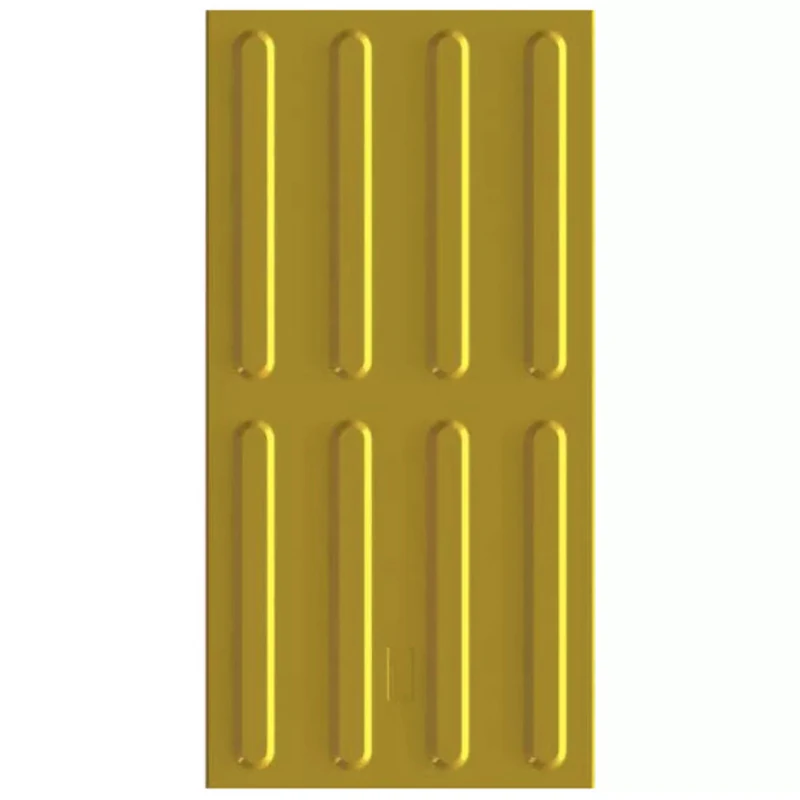
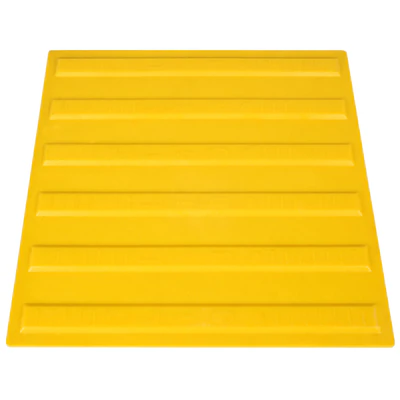
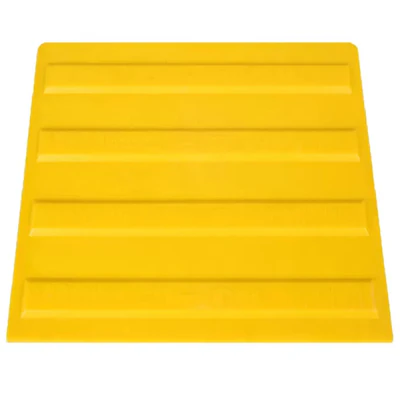
Touch mark for visually impaired people 300x600 mm is one of the most efficient modern solutions for guiding people with impaired vision in public, commercial and institutional spaces. Designed to meet the strictest accessibility requirements, this type of marking transforms any area into a safe, intuitive environment and in accordance with the rules in force.
In a world where accessibility is no longer optional, but a legal and moral necessity, the use of tactile paving for visually impaired people 300x600 mm becomes essential in the design of modern infrastructure. Whether we are talking about public institutions, office buildings, commercial spaces or busy urban areas, these markings contribute directly to the safe and independent orientation of users.
Why is a 300x600 mm tactile marking essential?
Touch markings are not simple elements of urban design. They are a universal language, perceived by touch and detected with the white stick, which transmits essential information:
- direction of movement
- stopping or danger areas
- changes in the path
- access to points of interest
Format 300x600 mm offer a clear advantage: extended coverage and logical continuity in the guidance routes, reducing the number of couplings and increasing the efficiency of the installation.
Technical characteristics of the tactile marking for visually impaired people 300x600 mm
Optimum dimension for continuous guidance
Plate of 300x600 mm is ideal for long tactile paths, providing a generous surface and a clear directional perception.
Tactile structure according to standards
The markings shall be made with:
- longitudinal ribs – for directional guidance
- or Cottons (gifts) – for warning
These forms are standardised and internationally recognised.
Durable and durable materials
Manufacture from materials such as:
- High density polyurethane
- Industrial PVC
- Stainless steel or aluminium (in premium variant)
Resists:
- intensive pedestrian traffic
- humidity and UV
- temperature variations
Anti-skid surface
Safety is a priority. The surface is treated to prevent slippage, even in conditions of rain or ice.
Versatile Assembly
It may be installed:
- with professional adhesive
- mechanically (screws/dilutions)
- on concrete, gravel, asphalt or wood
Where is the 300x600 mm tactile marking used?
Public spaces and institutions
- city planning
- hospitals
- Schools and universities
Commercial areas
- malls
- supermarkets
- Showrooms
Urban infrastructure
- walk
- Transport stations
- pedestrian crossings
Private buildings and offices
- receivers
- Halls
- Access routes
Advantages of using tactile markings for visually odded people
- increase accessibility of space
- reduces the risk of accidents
- comply with the legislation in force
- Improves the image of the company
- facilitates independent orientation
How does a tactile guidance system work?
The tactile markings function as a logical path, perceived by touch:
- Directional plates indicate the route
- Warning plates signal stop
- The combination creates a coherent flow
Thus, the user can navigate without visual help.
Difference between markings 300x300 mm and 300x600 mm
| Characteristic |
300x300 mm |
300x600 mm |
| Surface |
small |
large |
| Installation |
more pieces |
more efficient |
| Continuity |
mean |
excellent |
| Installation cost |
higher |
optimized |
Commercial benefits for customers
- ✔ Compliance with accessibility rules
- ✔ Increasing user safety
- ✔ Reduction of legal risks
- ✔ Professional image of the location
- ✔ Fast and efficient installation
- ✔ Long life
- ✔ Long-term reduced costs
FAQ – Frequently Asked Questions
What is a tactile marking for visually odded people?
It is a special relief plate used to guide people with impaired vision.
What's the difference between the gums and the nerves?
Bombs indicate stop/danger, and ribs indicate direction of walk.
Can it be mounted outside?
Yes, it is weather resistant and traffic intensive.
Is it mandatory by law?
In many situations, yes – especially for public buildings and commercial spaces.
How long does the installation take?
Usually fast – depending on the surface and type of assembly.
Need maintenance?
Minimum – only regular cleaning.