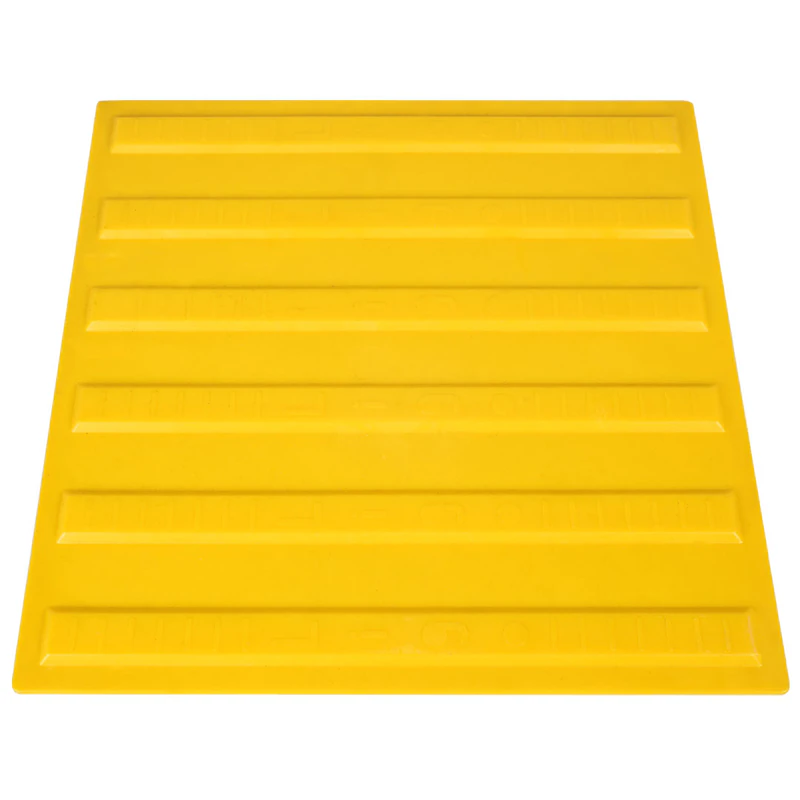
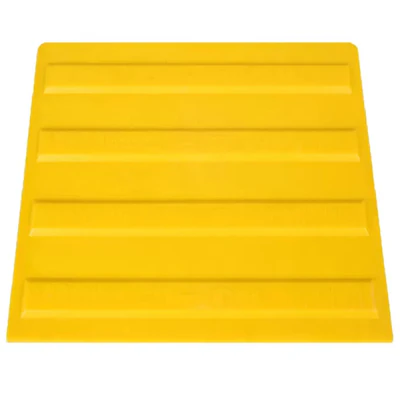
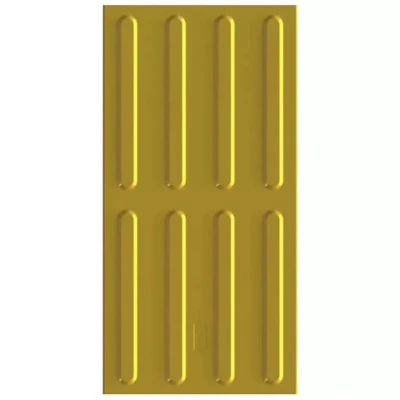
Touch mark for visually impaired people 400x400 mm is an essential element in accessible modern infrastructure, created to improve the safety and orientation of people with impaired vision in public and private spaces.
This type of tactile pavement for visually odded people is widely used in airports, airports, shopping centres, hospitals, office buildings, public institutions and busy urban areas, where visual orientation is not sufficient for safety.
In a modern society, accessibility is no longer a "more" obligation. And this touch guide system 400x400 mm is one of the most efficient solutions for independent navigation and reducing the risk of accidents.
What is the touch mark for visually odded people?
The tactile marking is a special textured surface plate designed to be perceived through the soles or the white stick used by the blind.
This system Tactical signalling for public spaces transmits key information such as:
- direction of movement
- warning of a dangerous area
- approach to steps, ramps or edges
- changing the pedestrian path
Standard size of 400x400 mm allows modular integration in existing or new floors.
Functionality and role in public safety
Intelligent guidance for people with impaired vision
This type of tactile marking podotactil 400x400 mm creates a ‘tactile map' on the surface of the ground, intuitively guiding the user.
Reducing the risk of accidents
By using a standardised relief system, the following shall be significantly reduced:
- slips
- falls on the stairs
- Wrong orientation in crowded spaces
Compliance with accessibility rules
The tactile markings shall be used in accordance with:
- urban accessibility standards (e.g.: ISO 23599 – touch guide)
- regulations on inclusive public infrastructure
- Universal design requirements
Where is the touch mark 400x400 mm used?
Essential public spaces
- railway stations and metro stations
- airports
- transport terminal
Commercial buildings
- malls
- supermarkets
- shopping malls
Institutions and administrative buildings
- city planning
- hospitals
- universities
Urban space
- walk
- Pedestrian crossings
- Intersecting areas
General technical characteristics
- Standard size: 400x400 mm
- Anti-slip touch surface
- Highlighted texture for rapid detection
- Mounting in flooring (lipping/mechanical fixing)
- Resistance to heavy pedestrian traffic
- High external and internal durability
- Compatible with modern public spaces
Functional design and intuitive orientation
This touch guide system for visually odded people is designed to convey the information unambiguously.
The relay shall be standardised:
- Direction lines
- Warning points
- Combined warning surfaces
This universal language allows its use regardless of language or culture.
IMPORTANCE OF MODERN ACCESSIBILITY
In contemporary architecture, accessibility is part of universal design.
One tactile marking for visually impaired people 400x400 mm It is not just a technical product, but a social inclusion solution.
He contributes to:
- personal autonomy
- independent mobility
- real urban integration
- safety in movement
Commercial benefits
- Increases safety in public spaces
- Reduces the risk of accidents
- Meets accessibility rules
- Mandatory solution in modern public projects
- Easy to integrate into existing infrastructure
- High durability over time
- Minimum maintenance
- Compatible with urban rehabilitation projects
- Improves user experience
- Increasing the quality of architectural projects
FAQ – Frequently Asked Questions
1. What is a tactile marking for visually odded people?
It is a special relief plate that helps people with impaired vision to orient themselves in public spaces.
2. Where does the 400x400 mm touch mark stand?
It shall be mounted on the floors in public, indoor or outdoor spaces in pedestrian traffic zones.
3. Is it mandatory in public buildings?
Yes, in many modern projects it is required by the rules of accessibility and universal design.
4. What material is made of?
It may be made of materials resistant to heavy traffic, wear and external conditions.
5. How do blind people help?
Through tactile feedback at the level of the foot or cane, providing directions and warnings.
6. Can it be used outside?
Yes, it is designed for indoor and outdoor use.
7. Is it compatible with other guidance systems?
Yes, it can be integrated into complex urban tactile signalling systems.