
Protection of cables on the roadway: how to choose the right passage
A roadway wire protection keeps cables and hoses away from the wheels of vehicles and reduces the risk of being prevented. In halls, warehouses, yards and events, canal crossings protect the electrical installation and slow traffic at the same time, without complicated works.
In short: numbers the cables, measure their diameter, choose 2, 3 or 5 channels and sit the passage on a clean, flat and well marked surface.
Do you need help choosing?
Tell us what you need and we'll send you the offer on the same working day.
A well-chosen cableway prolongs the life of the installation and keeps the access routes free and secure. Models with 2, 3 or 5 channels cover the usual situations in halls, warehouses, construction sites and events, and the colored cap warns drivers of time. Periodically check the caps and clean the channels, then replace the worn modules. Discover the models available in the Cable Protection category and choose the right pass for your route.
O Protection of cables on the roadway Solve two problems at once. So the cable no longer sits under wheels, and people no longer stop at it. In halls, on yards and at events, cables and hoses often cross access routes. It is therefore worth choosing the right transition from the planning stage.
In this guide you find the real models in the category Cable protection. Also, find out how you read the dimensions, how you set the number of channels and how you care for the passage through time.
Where you need cable protection on the roadway
Any cable that crosses an inner road becomes a weak spot. The wheels crush it, then the insulation cracks, and the connection can suddenly collapse. In addition, a free cable on foot creates a risk of preventing pedestrians.
Typical situations look like this:
- production halls, especially where the stackers pass over the power supply of a mobile machine;
- Logistic deposits, such as ramps and charging areas;
- construction sites, where the water hose and the power cable cut access to trucks;
- fairs, congresses and concerts, as stands and scenes require temporary feeding;
- commercial parking spaces with temporary lighting cables.
So, wherever a vehicle steps a cable, it deserves a dedicated pass.
How a cable pass works
The models in our offer combine two functions. On the one hand, the body has longitudinal channels in which you sit the cables. On the other hand, the inclined profile forces the driver to slow down. For example, the MFK manufacturer indicates a speed reduction of 10 km/h for its ramps.
The cap closes the canals from above. Thus, the cable remains covered, and the rolling surface becomes continuous. At the same time, the colour of the cap contrasts with the black body, so the obstacle is easily seen.
Real models and what differentiates them
Enerji 600x500x75 mm, for 3 cables
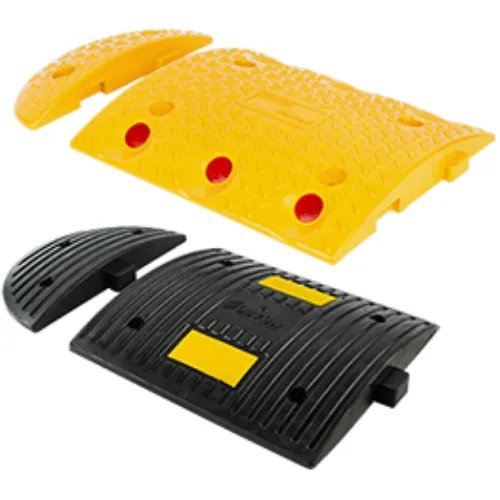
Model Enerji 600x500x75 mm for 3 cables has a black PPC body and a yellow cap. The manufacturer recommends it as a roadway cable protection, especially in factories, at fairs and at temporary events. It also indicates use between -20 and +60 °C. In addition, you find the option Protection Enerji for 3 PPC cables, useful for completing an existing route.
MFK 5852, 250x1000x50 mm, with 2 channels
Ramp MFK 5852 uses black vulcanised rubber and PVC orange cap. It has 2 different channels of size and weighs about 7.5 kg per mode. Therefore, it moves easily from one work point to another.
MFK 5855, 500x900x55 mm, with 5 channels
For loaded tracks, MFK 5855 offers 5 Channel. The module has around it 16 kg, so it's more stable under traffic. Instead, you carry it harder than a model with 2 channel.
How to choose cable protection on the roadway after diameter
First, they inventory everything they need to go through: power cables, data cables, hoses. Then measure each other's outer diameter. At the same time, it also takes into account moulds.
- Each cable or hose receives its channel, i.e. do not jam two lines together.
- Leave a small reserve of space because a tight cable is used faster.
- Separate, if you can, the power cables from the data.
- Think of the expansions, because a free channel today exempts you from a second passage tomorrow.
So, the number of channels is directly from your list. For example, for 2 lines MFK 5852 reaches, for 3 lines choose Enerji, and for 4–5 lines MFK 5855 passes.
Traffic decides profile and weight
To a cable protection on the roadway matters and passing over it. A small wheel lifter feels more like a high ramp than a car. However, a profile too low can leave the thick cable without space in the channel.
A few practical points:
- for pedestrians and carriages, low profiles, such as 50 mm, disturb less;
- Cars and light utilities pass well over 55–75 mm modules;
- In heavy machinery, however, it requires the manufacturer's data and verifies the permissible load of the passage.
In addition, a hard way slides less to brakes. Therefore, in areas with tight turns, a massive or anchored roadway cable protection behaves better.
Planning the route to events and construction sites
At an event, the cable track changes a lot. Therefore, it draws a simple plan first with the power source, the scenes and the access routes. Then mark each point where a cable cuts the road to vehicles or the public.
On the yard, however, access to trucks moves with the work. So, choose easy-to-lift modules, like MFK 5852, which you move without machines. Instead, in a flat-lined hall, it deserves heavy modules and a permanent grip.
At the same time, think about pedestrians. A passage sitting in the middle of a crowded corridor becomes itself an obstacle. That's why it signals the heads and lights up the area at night.
Mounting for roadway cable protection
First, measure the width of the access path. Then divide the width to the length of a module. For example, a 4-metre track requires 4 MFK 5852 modules, each 1000 mm.
Basic steps:
- cleans the surface of dust, oil and gravel;
- open the caps and place the cables straight, without loops;
- combine the modules and close the caps;
- verify that the passage is planned, without legensation;
- Mark the heads of the route, especially in the weakly lit areas.
For permanent installation, you can anchor the modules in the floor. In this case, check first which installations pass through concrete.
Maintenance and verifications for a cable crossing
A neat passage takes a long time. However, it needs a few simple checks:
- Every day, at events, check if any lid has been opened;
- weekly, in halls, clean the dust and debris channels;
- pursue the insulation of cables at the ends of the passage, especially where they bend;
- replace the cracked or deformed modules.
It is also worth including every cable protection on the roadway in the internal security plan. For the general rules of warehouses and warehouses, you can find information at Labour Inspectorate.
Frequent errors in cable crossings
At a roadway cable protection, many faults arise from hurry, not from the quality of the product:
- cables left in the loop under the lid, which lift the module at each pass;
- jointed modules twisted because the surface had gravel;
- Channels filled with excess capacity, i.e. time-streaked insulation;
- Unmarked heads, therefore hard to notice at night.
In conclusion, a few more minutes at the assembly saves you hours of troubleshooting.
What other equipments fit
Sometimes the real problem keeps speed, not cable. In this case, see speed limiters Modular. For the entire internal streets, though, limiting sets I come with heads included. So you can combine the passage with a separate limiter, a few meters away.
Frequently Asked Questions about Cable Protection on Roadway
Can I get hoses through a cable bridge?
Yes, if the outer diameter fits without crushing. However, it keeps the water hoses in channels separated from the electrical cables.
How many channels do I need?
Count the lines that cross and add one backup. So choose between 2, 3 or 5 channels.
Can you resist the switch to outside?
Manufacturer Enerji indicates use between -20 and +60 °C. For other models, however, consult the product file.
Can I only use it temporarily?
Yeah. Modules sit and tighten quickly, which is why they often appear at fairs and events.
For a roadway cable protection suitable for your route, enter the category Cable protection. The Blocator.ro team helps you compare models and set the number of channels.